Know exactly 'What Changed?'. Introducing ZapFolder's Version Narrative Agent
Every time a new file version lands, the same question slows your team down: "What actually changed?" ZapFolder's Version Narrative Agent reads two versions of a file and instantly generates a plain-language summary, both internal and client-facing tones so you stop reconstructing change history from memory and start delivering with clarity
Every creative team knows the moment.
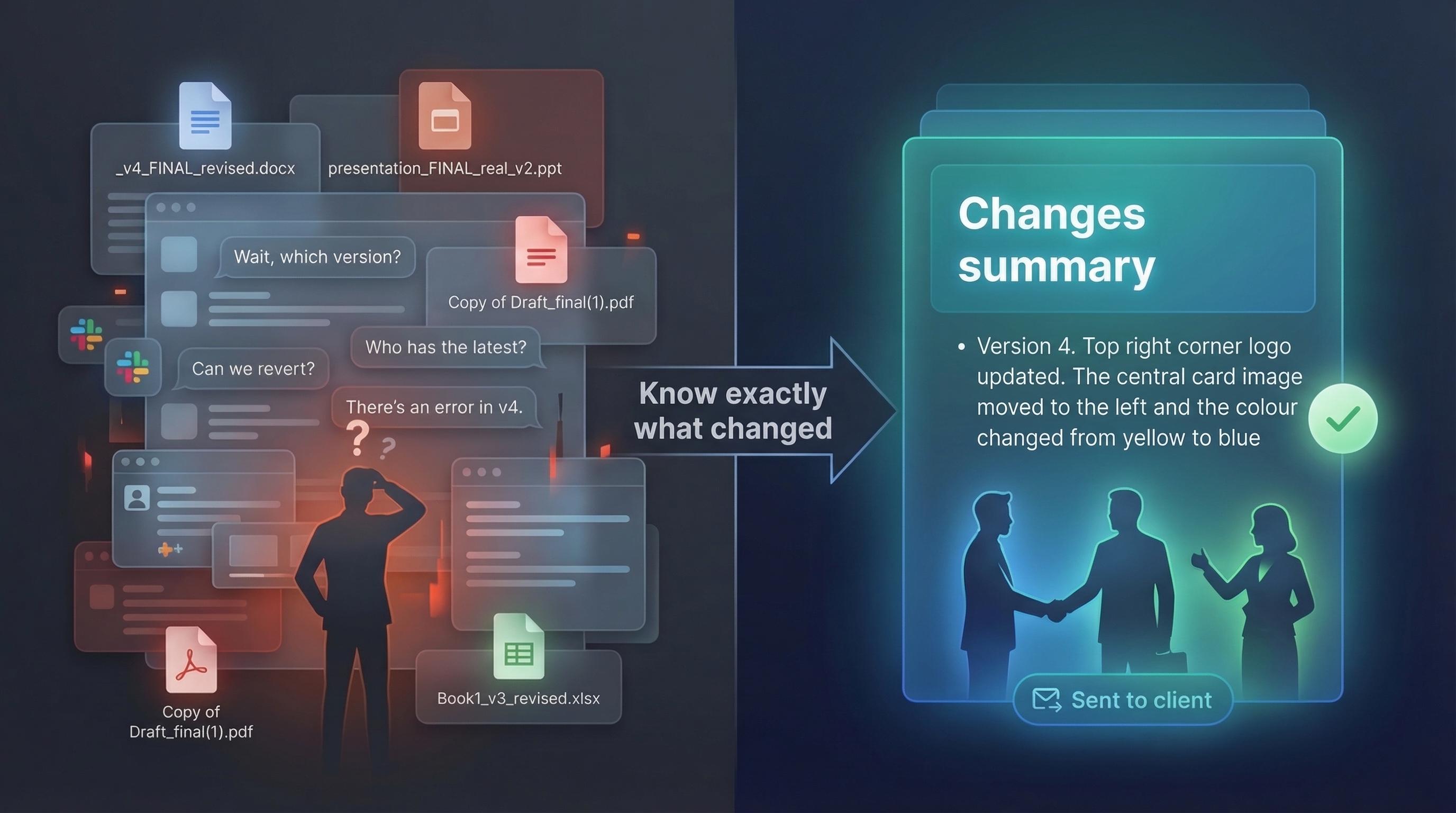
A new version lands in the shared folder. The filename says _v4_FINAL_revised. Nobody's quite sure what's different from v3. Someone pings the designer. The designer digs through their own notes. Ten minutes later, a Slack thread explains something that should have been obvious at a glance.
This isn't a communication problem. It's a tooling problem — and it's exactly what ZapFolder's Version Narrative Agent is built to fix.
The Hidden Cost of "What Changed?"
Every time a new version of a file is delivered — a deck, a video cut, a design, a document — the same question surfaces:
What's actually different here?
Stakeholders aren't sure where to focus. Reviewers try to remember what was requested and end up re-checking things that didn't change. Time gets wasted on coordination that should be instant.
For clients, it's worse. They're already less familiar with the work. An unexplained update can feel like a black box. This undermines trust and invites more back-and-forth. Not ideal.
The traditional answer has been a manual changelog, a summary email, or a Slack message someone writes from memory. These are good intentions, but this process is broken.
What the Version Narrative Agent Does
ZapFolder's Version Narrative Agent reads two versions of the same file and generates a plain-language explanation of what changed — and, importantly, why it matters.
It's not a list of file metadata. It's a human-readable summary that anyone on the project can actually use.
For example:
Version 4 updates the hero section copy across slides 2–4, replaces the placeholder chart on slide 7 with final Q1 data, and removes the legal disclaimer on slide 11 following sign-off. The overall structure and branding are unchanged.
That's the kind of update that used to live in someone's head — or in a rushed Slack message that half the team missed.
Two modes, built for two audiences
The agent generates summaries in two tones:
- Internal review mode — direct, specific, built for your team. Designed to help designers, producers, and project leads orient quickly.
- Client-facing mode — clear and professional, written to be shared externally. Suitable for an update email, a portal note, or a delivery message.
You choose the mode. You review the output. You decide whether to send it as it is or edit it first.
Human-in-the-Loop by Design
One thing worth being clear about: the Version Narrative Agent is not an autopilot.
It doesn't automatically send anything. It doesn't decide whether a change is complete, correct, or approved. All of that stays with your team.
What it does is eliminate the blank page, the moment where someone has to reconstruct what changed from scratch under time pressure. The agent drafts a starting point. A human reviews it, edits if needed, and sends.
This matters because version summaries often carry real weight. They go to clients, stakeholders, or partners. They need to be accurate. They need to match your tone. The agent makes them faster to produce without removing judgment from the process.
Where It Fits in Your Workflow
The Version Narrative Agent is most useful in two of ZapFolder's core workflow modes:
Review Mode — when a revised asset is ready for feedback or sign-off. Instead of asking your client to spot the differences themselves, you send a clear summary alongside the file. Review cycles get shorter. Confusion gets eliminated upfront.
Distribution Mode — when you're pushing an updated version out to a list of stakeholders. The agent's change summary becomes the natural companion to the delivery — explaining the update without requiring anyone to write it from scratch.
The Bigger Picture
ZapFolder's approach to AI isn't about replacing the people doing creative and collaborative work. It's about removing the low-value friction that slows them down.
The Version Narrative Agent handles one specific, recurring job: explaining what changed, in language people can actually use. Nothing more, nothing less.
When that job is done well, your team spends less time on coordination overhead and more time on the work that actually matters.
The Version Narrative Agent is part of ZapFolder's agentic roadmap, currently in development. If you're interested in early access, get in touch.